Tuesday, September 13, 2005

More on Arab TV

Studying a foreign language in middle school was a virtual Rosetta Stone for me: all of a sudden I was endowed with a pretty good framework to apply in English, too. So this cartoon, by Hindawi for al-Ghad, might serve as an eye-opener for those who pooh-pooh the medium. From right-to-left—this is an Arabic-speaking audience, after all—we see the three types of Arab television viewers: those primarily concerned with the news, those taking in the video-clips, and the reality TV fans, marooned in front of the set. [Via Abu Aardvark, of course.]

Hindawi cartoon

Labels: , ,

Monday, September 5, 2005

Reality

In the beginning of the summer, it looked to be a fairly dismal TV season, with only a few items warranting notice:
  • True Entertainment, a reality TV production company and subsidary of Endemol (oh, no, that’s Big Brother's Big Brother) announced in July that they’re looking to air a new series centered around contestants looking to be political operatives when they grow up; in other words, they’re looking for the next, better-looking, Karl Rove. I would actually watch this show, which bodes ill for its future;
  • The continued delight of “Laguna Beach,” (MTV, Mondays at 10p) and the sudden shock that “Big Brother 6” (CBS; Tuesday at 9p , Thursday and Saturday at 8p) was watchable and even kinda interesting, despite the long (and continuing) history of insipid contests and contestants. This season, though, we are treated to a substantial population who avow that the secret to winning is by playing smarter—it almost never works out that way—and blessed with a group who think they are smarter than they really are.
separator
Haifa Wehbe with goats (For Her)
Haifa Wehbe on the cover
of For Her

But, as usual, the most illuminating and important stories are taking place outside of our field-of-view: in the Arab world, “Al-Wadi,” a reality program that looks to be a hybrid between “Big Brother” (the popular Middle East Broadcasting Centre edition of the franchise was abruptly cancelled in last year’s inaugural season) and “The Simple Life,” is aired by the Lebanese Broadcasting Corporation and is taking the region by storm.

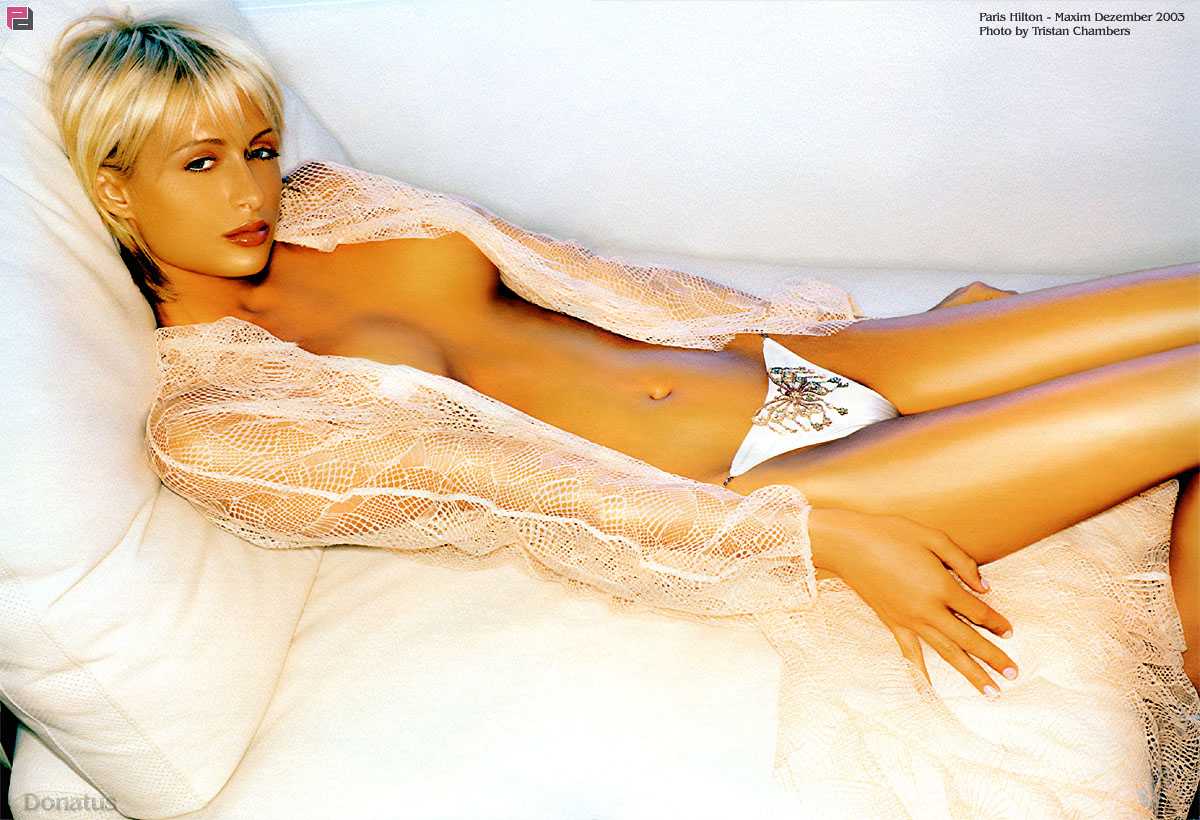
On “Al-Wadi,” video-clip siren Haifa Wehbe plays Paris Hilton [see inset, left]; so, the esteemed Abu Aardvark can be expected to be on the case in his usual coverage of The Nancy-Haifa Culture Wars. The show’s website has to be seen to be believed; anyone who watches the slightest bit of reality television will have no problem recognizing common scenes, tropes, and situations. Here’s Haifa, clad in a L.A. Lakers tank-top, in a snap that could be out of the American BB; and a fetching Haifa posing with a burro (images courtesy of Marc Lynch).

Labels: , , ,

Pamuk’s Istanbul, and mine

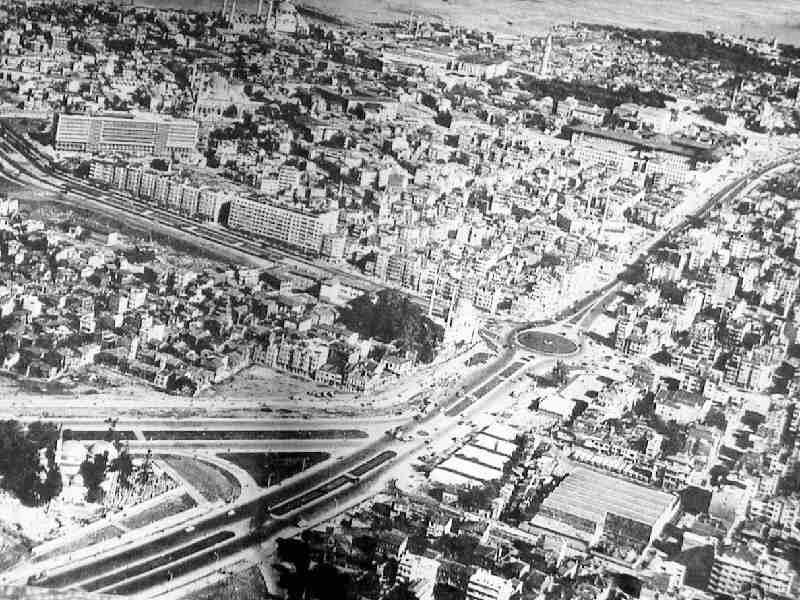
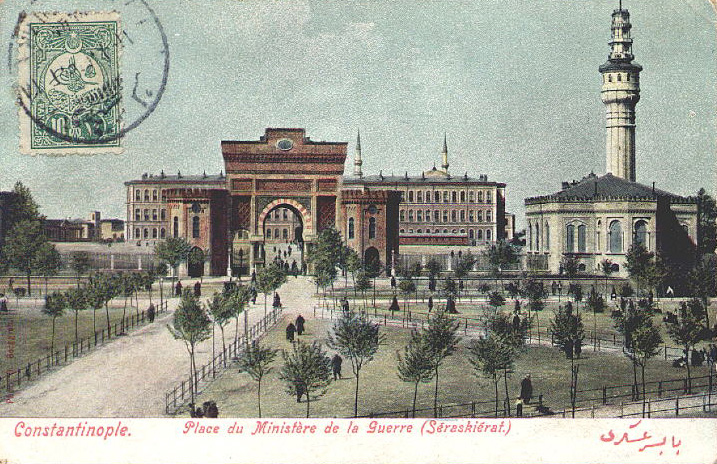
I impulsively journeyed to Istanbul as a young man in the early 1980s, after I discovered a Victorian travelogue (Constantinople: City of the Sultans, by Clara Erskine Clement) in a Santa Barbara antiquarian bookstore (here, I think, though I can no longer be certain). It was a peculiar time to visit—I arrived to guns on the tarmac unaware that the city was under martial law, and that the Turkish economy was in shambles—but in many ways it was the perfect moment. Even as the population had grown steadily since the 1960s (and was to take off around 1980), much of the boom was on the Asian side of the Bosporus, as well as on the outskirts of the European city, in sprawling shantytowns I encountered on the bus-ride from the airport to the old city.
Istanbul panorama
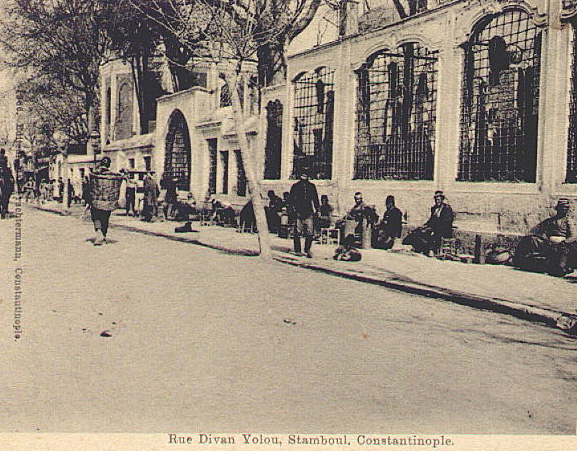
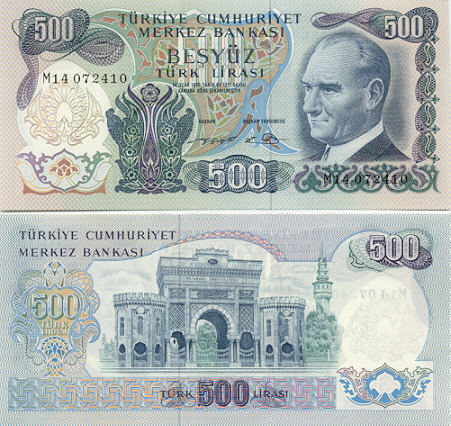
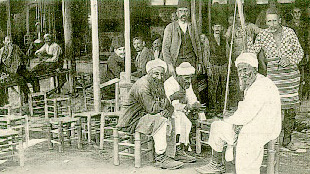
Upon disembarking in Acksaray, walking down the muddy, semi-paved street towards Sultanahmet, I wandered (and wondered) for weeks, primarily on the south side of the Golden Horn—haunting the mehanes, the pudding shops, and the dark tea houses with raki-drinking, television-watching, middle-aged men, the omnipresent visage of Atatürk overlooking the proceedings; streets filled with the clacking of printing presses (plus the occasional chorus from Thriller) and narrow passageways with old men smoking hookahs; the heavy quiet of Beyazit Square on a hot summer afternoon, with a nearby convenience store on the southern outskirts selling lukewarm ayran, or warm Pepsi out of wooden crates, or black currant juice (my favorite); the outdoor market amidst traditional wooden houses in Vezneciler, with tables of slender, striated Asian eggplant; the medical school with the fluorescent-lit vitrines, showcasing hand-painted, plastic models of the human body; the rural snack-sellers of simits, roasted ears of corn, cucumbers-peeled-before-your-eyes, and the minced-mussel sandwiches vended by watermen.

separator

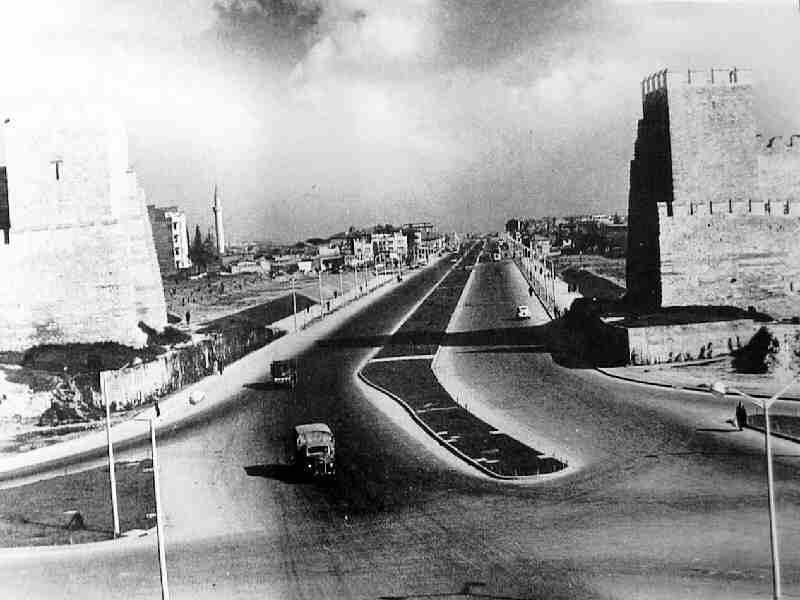
When I returned in 1997, the city was almost unrecognizable to my eyes. Some fifteen years had past, but so little remained the same, or seemed to remain the same.
Pamuk's Istanbul
Hüzün-y!
There was a tram running from Topkapi, the Cannon Gate of the walled city (where I had departed, overland, to Greece on my maiden visit—then, the ‘bus station’ consisted of a muddy field and plywood kiosks serving as ticket booths) down to Sultanahmet, the touristic epicenter of the old city. There was a subway, too, and bars that wouldn’t be out of place in Soho. But the disparity between what I had experienced on the two trips left little doubt that not only had Istanbul changed radically, but I had, too. Parsing these changes, and their degree, has been an important question, critically, in understanding my place in the world. So this year’s occasion of the English translation of Orhan Pamuk’s Istanbul: Memories of the City was a significant and meaningful landmark. Pamuk is ten years older than I am, and his experiences center around the middle-class, European city laying to the north of the Golden Horn, but his account of the "city of sultans," filtered through the eyes of the West—the author argues that Istanbuli cannot, by the circumstance of history, understand their city in any other way—allows this Westerner to make a little more sense of what I experienced over twenty years ago.

Bosporous map detail

Memories has been well-received in the Anglophonic world (and discussed in the litblogs, too); everyone properly focuses on the river of hüzün—that peculiar brand of Stamboul melancholy derived from the loss of Ottoman grandeur—that flows through the city, but there are a few old saws to avoid, too. Pamuk is pointedly wary of the “torn between East and West” interpretation of the Turkish character, one that I had trotted out in my writings when I was lad in trying to describe the men (and it was almost always men, then) I met in my travels, shoeblacks and tea-boys and soldiers, many of who seemed to be carrying the weight of the world on their shoulders. Even when I declined to have my boots shined, they would buy me a beer or take me to Friday prayers.

separator

Many of the more gratifying highlights of the book come when Pamuk describes four of the writers he most admires; one, Reşat Ekrem Koçu, the author of the never-completed Istanbul Ansiklopedisi, spools a discussion that captures the wonder of the city through publishing (!): a tour of other popular Turkish encyclopedias, including the mysteriously-illustrated From Osman Gazi to Ataturk: A Panorama of Six Hundred Years of Ottoman History. Pamuk’s memoir is highly recommended, and—for this reader, who cannot speak the Turkish language and has been unable to find a contemporary social history of the city for some time—essential.

Labels: , , ,

Saturday, September 3, 2005

West by East

ka‘aba

I think democracy exists in the West because the West has had the novel. And despotism reigns in the East because the East has had poetry. The novel develops the democratic imagination because it offers various paths, various destinies, while poetry is despotic.

—Sorour Kasmai

separator
Nisaburi Virgin with Child
Virgin with Child (1595), from
Nisaburi’s Stories of the Prophets
Bibliothèque Nationale de France

Some have harrumphed that there are a paucity of exhibitions of Middle Eastern artists in the West: this stems, in part, from a variety of reasons that sound suspiciously like Orientalist arguments, but really aren’t. I've long lamented that curators aren’t drawn from broader stock, but it’s well-neigh essential when we’re looking at the Islamic world, where the fine arts are less Western and comingled with religious tradition. Fortunately, the Centre de Cultura Contemporània de Barcelona has enlisted Tunisian writer Abdelwahab Meddeb to curate West By East, an exhibition that examines an “Occidentalist” view of the world, a notion that is gaining strength over the past year (witness this exquisite examination of Istanbul, filtered through Western eyes by future Nobel Laureate Orhan Pamuk). Meddeb, a multidisciplinary character who demonstrates a broad knowledge of the history and culture of both East and West, knows literature and art history (it shows). The Times has a piece on the show in today’s paper; after closing on 25 September, WBE will be decamping for Valencia.

Labels: , , ,

Tuesday, April 19, 2005

Islamic graveyards

Don Milstead, my high school teacher in American history, used to explain how he always visited graveyards when travelling; now, I do the same—on my way to Maryland's eastern shore, or in Los Angeles, or Paris, and in the Muslim world, too.

Süleymaniye cemetery
Old Ottoman cemeteries—the grounds of the Süleymaniye mosque in Istanbul—have headstones decorated with headgear that the man wore during his life on earth (in premodern times, at least): one frequently sees fezzes or turbans atop the tall, vertical pillars that mark the gravesite, or flowers and sea shells for the graves of women.

City of the Dead Cairo

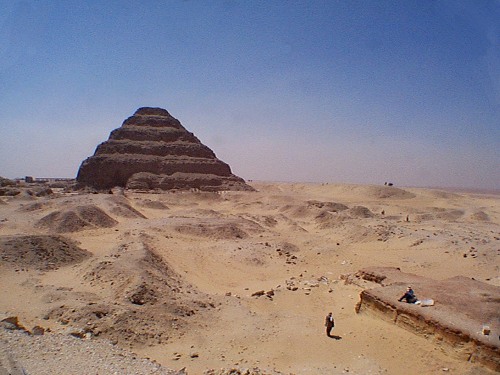
The graveyards I have visited in north Africa and the middle east are exotic and often beautiful to my Western eyes, but none are as striking as the medieval cemetery in downtown Cairo known throughout the West as the City of the Dead. When I first laid eyes on the CotD, its monochromatic duskiness piqued my interest immediately; the "northern cemeteries"—once outside the city (as is traditional in Islamic societies) but long ago overtaken by nearly 20m residents—is a shantytown where living Cairenes coexist with the interred. It's a fascinating place with a culture all its own, and is as important to visit as the pyramids.
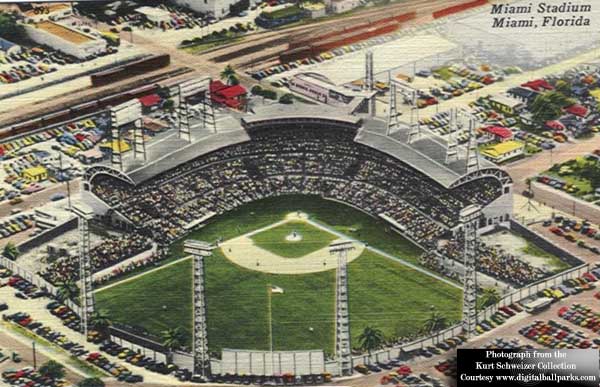
Excerpted images from two slide shows (here and here) on the City of the Dead may be found here (0 1 2) and here (0 1 2 3 4).

Labels: , , , , ,