Tuesday, November 15, 2005

“The Worst Record Covers of All Time”

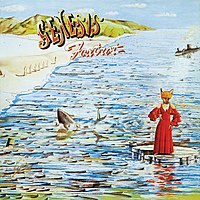
Genesis’ Foxtrot
Genesis’ Foxtrot

Why do hipsters reject Genesis? Animal Collective couldn't try any harder to mimic them, from the prog-jamming down to the stupid album art.

—Brent DiCrescenzo
The Worst Record Covers of All Time,” on Pitchfork

[via Troy]

Labels: ,

Sunday, September 18, 2005

Bad mags

Tom Brinkmann’s site for Bad Mags, a book “due in 2005,” is such a train wreck you might find it curious that I’m citing it as rich in design resources, but there it is.

Where It's AtSultry
National Informer
Inside Detective
Dig deeper: there’s an impressive collection of sixties and seventies zines, sorted by category (Sharon Tate, true crime, occult sex, bikers, punk, blue films) and by publisher (I’m unfamiliar with their names—Seven Seventy, GSN/Classic, TNC/Dominion, Pendulum/Gallery Press, Sari/Press Arts—but almost all of them were based in Los Angeles or the San Fernando Valley and carry particular house vernaculars). Warning: the website loads pretty slowly, so you might want to get a cup of coffee in the meantime.

Rascal
Confidential
Fiery Films
Hefty
A small sampling of the wares, displayed here (click through for larger images from the website), reveal some pretty cool work, heavy on the clip art and tabloid look but graphically bold, smart, and fun. (Note that promiscuous font-mixing has a long and glorious history, even in the days of paste-up.)

Labels: , , ,

Tuesday, September 13, 2005

illy’in’

From illy, the coffee folks, a collection of espresso cups and saucers designed by Padraig Timoney and based on “lines and doodles from actual pen tests.” Nice, but a cool $120 for six of each. (There are pen-test sets for two, and numerous other artist-designed cups, from Jeff Koons to Maria Abramovic.)

'Pen Tests' by Padraig Timoney

[Via Cindy]

Labels: ,

Tuesday, August 9, 2005

The Pit

The Pit!
The Pit #6
(Click here to check out the photo set.)

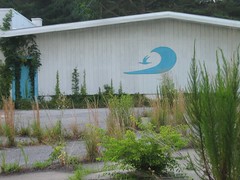
Over vacation, I took a few snaps (0 1 3 4 5) of an abandoned bar—perhaps a strip club—on a drive over U.S. 13 through the Delmarva peninsula (for folks outside of the middle Atlantic, that’s the piece of land that separates the Chesapeake Bay from the Atlantic Ocean, a portmanteau of parts of Delaware, Maryland, and Virginia—once abbreviated “Va”).

“The Pit” was decorated in 1970s-vintage imagery, rendered in painted wood. Particularly groovy is the “the,” crudely jigsaw-ed and just barely visible (underneath flora) here.

Labels:

Thursday, July 28, 2005

Kaus on Roberts

Supreme Court nominee John Roberts appears to drive a Chrysler PT Cruiser. This may be the scariest thing I've heard about him.... Probe this issue thoroughly, Sen. Schumer!

—Mickey Kaus, in Slate

Labels: ,

Friday, July 15, 2005

The best album cover in a long time

Statistics' 'Often Lie'

(Click here for a magnified image, and here for details about the release.)

Labels:

Friday, July 8, 2005

MoCo Loco roundup

It’s been a while since I’ve visited MoCo Loco, a great modern design site, and I spent some time this afternoon catching up on their archives. Several bits caught my eye (click images for more info):

Serra at the Bilbao
Johnston MarkLee Sale house
Lumino light
fabprefab

Labels:

Tuesday, July 5, 2005

Pink

iPod mini


Paul Simenon of the Clash once said to me, “Pink is the only true rock ’n’ roll color.” Apparently, they painted all their equipment pink for a tour.


—Luella Bartley, as told to BlackBook, in their spring 2005 issue.

Labels: ,

Wednesday, June 8, 2005

There's text in them thar hills

Hollywood sign rear view

There’s no real iconic building in Los Angeles. The city’s symbol, if one exists, is the “Hollywood” sign, built atop Mount Cahuenga in the 1920s to flog a real estate development. I first visited LA in the late 1970s, touring by city bus, always amazed when the sign would reveal itself to me. It still holds a sense of wonder, many years later: a graphical sign looming above the city.

separator

During interleague play (over the weekend of the 20-22 May), Goff and I saw the Los Angeles Angels of Anaheim take on the Dodgers in Dodger Stadium,
Think Blue
my first visit to the storied ballpark. The cheap seats were a lot more entertaining than attending an Orioles game at Camden Yards, especially for the surprisingly contentious rivalry: the largely Latino crowd (with entire families dressed in Dodger Blue or Angel Red—did the Angels’ brain trust know what they were doing when they tacked Bloods to the Dodgers’ Crips?) was vocal and good-natured, jeering the opposition throughout the tautly-played game.

When Eric Gagné—recently returned from the DL—entered the game in the ninth, the entire stadium blasted off. In the shadow of the left-field “THINK BLUE” sign, though, the Dodger offense would not prevail.

separator

If you spend any time driving about the American west, one will come across monograms,
Western State College 'W'

spelled-out in white stone, on mountains and hillsides above town. These signs largely date from 1905-1915, and were constructed by students from high schools and colleges to trumpet school and/or class spirit (the original is apparently Cal’s “Big ‘C’” on the Berkeley hills, as documented in 1988 by James Parsons in Landscape, v. 30, no. 1, and reprinted here).

For those who yearn for the east coast to get into the act, check out the Murrysville tree sign, a Pennsylvania herald fashioned by planting fir trees spelling out the town name in a clearing, a sign that's still visible.

Labels: , , ,

Thursday, May 5, 2005

Oh, dear: Crabtown

lit map inset

Artist: Ron Roos
Title: An Udderly Unique Maryland Species, sponsored by Linehan Family Foundation, Inc.
Description: A white crab with black, Holstein cow markings on front and back. Its back is includes an inscription about agriculture and the health of the Bay.

Crabtown central; more submissions from the Baltimore City website.

Labels: ,

Tuesday, May 3, 2005

A literary map

lit map inset

In this Sunday's book review section of the Times, a proposal from "ethicist" Randy Cohen to produce a map of literary map of Manhattan, marking where famous fictional characters live in the metropolis,

I began thinking about this map years ago while reading Don DeLillo's ''Great Jones Street.'' Bucky Wunderlick gazes out the window of his ''small crowded room'' at the firehouse across the street. I realized: there's only one firehouse on that street and few buildings that contain tiny apartments rather than commercial lofts. I know where Bucky Wunderlick lives. Or would live if he existed. He's got to be at No. 35. Knowing this made walking around the neighborhood like walking through the novel. But I walked without a map. Shouldn't there be a map of imaginary New Yorkers?

It's a collaborative effort; submit suggestions here.

Labels:

Tuesday, April 19, 2005

Islamic graveyards

Don Milstead, my high school teacher in American history, used to explain how he always visited graveyards when travelling; now, I do the same—on my way to Maryland's eastern shore, or in Los Angeles, or Paris, and in the Muslim world, too.

Süleymaniye cemetery
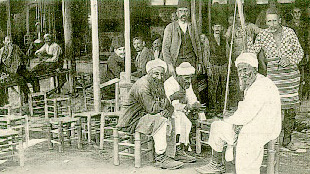
Old Ottoman cemeteries—the grounds of the Süleymaniye mosque in Istanbul—have headstones decorated with headgear that the man wore during his life on earth (in premodern times, at least): one frequently sees fezzes or turbans atop the tall, vertical pillars that mark the gravesite, or flowers and sea shells for the graves of women.

City of the Dead Cairo

The graveyards I have visited in north Africa and the middle east are exotic and often beautiful to my Western eyes, but none are as striking as the medieval cemetery in downtown Cairo known throughout the West as the City of the Dead. When I first laid eyes on the CotD, its monochromatic duskiness piqued my interest immediately; the "northern cemeteries"—once outside the city (as is traditional in Islamic societies) but long ago overtaken by nearly 20m residents—is a shantytown where living Cairenes coexist with the interred. It's a fascinating place with a culture all its own, and is as important to visit as the pyramids.

Excerpted images from two slide shows (here and here) on the City of the Dead may be found here (0 1 2) and here (0 1 2 3 4).

Labels: , , , , ,

Hex

Acoustic locators were deployed, between the world wars, to listen for noise from the engines of warplanes. Here, from the 1930s, a remarkable machine on trial in France [above; link to page with other outsized hearing aids]; each of the four assemblies carries thirty-six small hexagonal horns, arranged in six groups of six. [via Coudal]

Labels: ,

Monday, April 18, 2005

Viral marketing

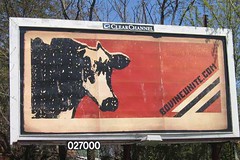
It began with the billboard in a rundown neighborhood on Greenmount Avenue
Constructivist billboard
BovineUnite.com billboard, just north of 26th St.
on Greenmount Av. at the railroad overpass.
(For large image, click
here. )
[inset] and the moneyed website (the splash demands to know whether visitors are cow or human; Homo sapiens are admonished to exit immediately). Then, stationed in front of the Fells Point post office on Tax Day, a costumed Holstein-Friesian was doling out Milk Duds (in something that looked like the old box, no less) to puzzled passersby.

The handsome constructivist-inspired site doesn't divulge what's going on, but promises news on the 5th of May: stay tooned.

Labels: ,

Thursday, April 14, 2005

Unbuilt Moscow

From the 1930s to the early 1950s: Unrealised projects in Muscovite architecture; Aeroflot Building [above], D. Chechulin (1934). [via Design Observer]

Labels: , , ,

Monday, April 11, 2005

Three findings on hotels

front desk at Casa Camper
It looks as if it’s time for a visit to Barcelona. Although my last visit there resulted in a picked pocket, I’m willing to risk a shameful visit to the local police station for a stay at Casa Camper (spectacular website, by the way), a design-y dream in the Catalan capitol’s El Raval district.
FoodBall
Adjacent to the hotel is FoodBall, the shoe manufacturer’s new health-food shop which features simple, reasonably priced natural rice balls (without additives, pesticides, chemical fertilizers, or genetic manipulation) that come with condiments and are served in natural or biodegradable wrappers (see this nice overview in Food & Wine).

Hotel interiors were designed by architect Fernando Amat, owner of Vinçon, Spain's answer to Terence Conran. Foodball whimsy is due to Martí Guixé (slogan: "brilliantly simple and curiously serious") in collaboration with the Camper Innovation Centre Son Fortesa. And then, of course, there are always the shoes.
Invisible Hotel, a Greek conference and exhibition promises a little more than it can deliver, at least for those of us unable to attend the actual forum in Athens (from 19 through 23 April). The site, although a little obtuse, is worthy if only to take in the event's smart logo: portions of the letterforms are rendered invisible.

Next up: Project Fox, a collaborative effort to support and promote young artists and designers by marrying the talent to the developers, is celebrating its big launch of their Copenhagen hotel, club, and recording studio this month—for just about the entire month. From the website, "Project FOX brings together young artists, designers, cooks, hotel industry professionals and managers to develop and implement their own ideas." Check out the room thumbnails above, and then click through and gape. I never thought of visiting Denmark until now.

Labels: , , ,